Other blogs
- Hot stuff!
- Danielle VUONG
- Raychel
- Ry-photo
- Matt-duh
- Sharon in Austria
- Calvin in Europe
- The asian crew in Europe
- Sharon
Wedding Pics
Archives
Tuesday, January 12, 2010
Predictions for 2015...
Well, Copenhagen was a disaster as we all know. The island nations that are most affected by climate change decided that negotiations were going no where and walked out. China doesn't want to make binding agreements to cap emissions because they don't want to be permanently locked at a level below the developed nations. The US doesn't want to make strong cuts because industry is fighting too hard to keep growing. We are in an economic depression and no one wants to fork out cash over wishy-washy targets.
I think a big problem is that, despite all evidence to the contrary, people don't see that they personally are being affected. In fact, most people see climate change and global warming as equivalent. If any part of the world is getting colder, then the whole theory is bunk, right? The fact that Europe is going through a cold spell only increases doubts. But a freezing of Europe is exactly what we expect with climate change! Increases in CO2 has trapped heat, which then has a variety of global effects. One big one is the melting of the ice caps, which in effect makes the ocean less salty and less dense. The Gold Stream has warm water travelling to the poles - it cools on the arctic ice and sinks. With the melting ice caps, the process is slowing down. The Golf Stream slows down, which means cooler air blows across Europe. The last time this "oceanic conveyor belt" stopped was when a large (glacial) freshwater lake burst open into the ocean, and this caused "the little ice age". Recent ice cores have shown that it was only 6 months for the ice to appear!
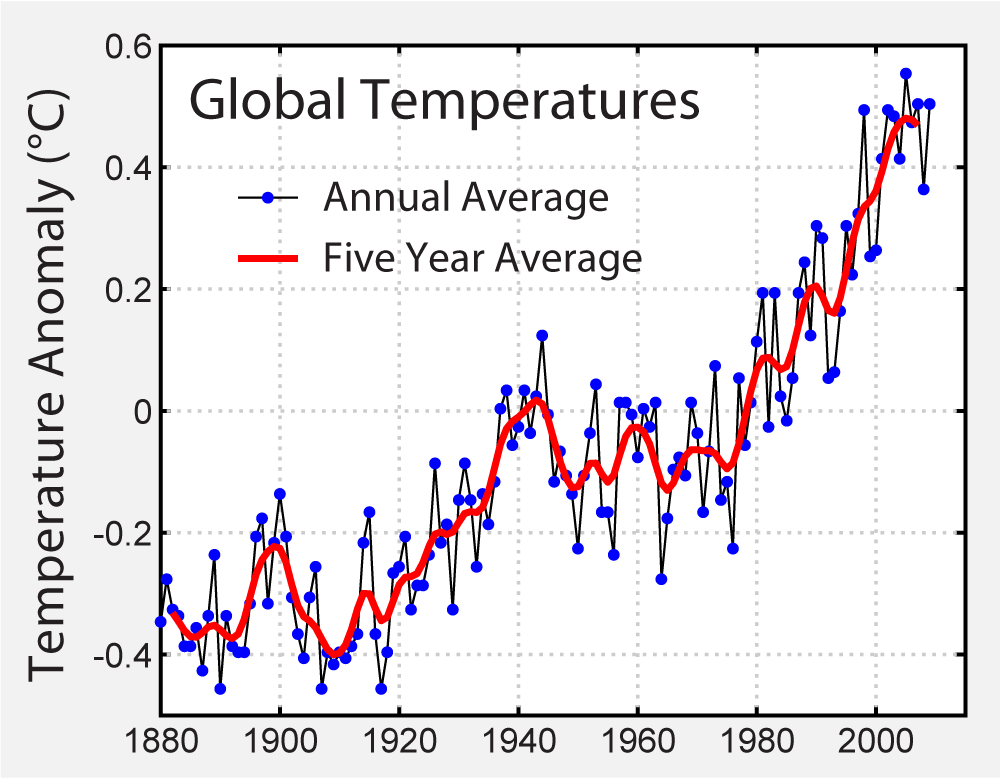
Another reason climate change is being disregarded is that temperatures are not rising steadily. We have not had a heat wave as bad as in 1995 to shake us up. The heat wave of the mid nineties caused enough of a scare to forge the Kyoto agreement. Why isn't it as hot as then, if there is more CO2 now? Well, like all the climate skeptics will remind you, the planet has it's natural temperature cycles. There is a small heating/cooling cycle 10 years long, and another every 60 years or so. Check out the graph. We are currently in the cooling part of both of these cycles. I figure in 2015, we'll be at the max for the 10 year cycle, and on the up for the 60 year cycle. We will see the hottest summer temperatures yet in North America, and Europe will lose the benefit of the Golf Stream. We will be seeing "climate change" that affects us all.

At this point, governments will get together to forge a real climate treaty based on fears, like they did with Kyoto. Copenhagen will hopefully have succeeded in creating a useful framework for future treaties so it isn't a rush job. The unfortunate part is that damage will need to be done for this to happen, and that the damage will have momentum. Just like the hottest day of the year happens months after the longest day of the year, effects of CO2 will continue for 100 years after we stop emitting.
I also susect this climate shift will, directly or indirectly, give that small downward push for a few key economies balancing on the edge. Japan is over its head in deficit, and may possibly start another economic crash. The timing of this economy collapsing is uncertain even to economists, I just don't think it would survive a hit from climate change. Global economies have already taken a big hit and will not be so rebust this time around, and nor will they rebound as fast. However, there is a silver lining - hurting economy will have a small benefit towards climate, as less business means less factories running.
I think a big problem is that, despite all evidence to the contrary, people don't see that they personally are being affected. In fact, most people see climate change and global warming as equivalent. If any part of the world is getting colder, then the whole theory is bunk, right? The fact that Europe is going through a cold spell only increases doubts. But a freezing of Europe is exactly what we expect with climate change! Increases in CO2 has trapped heat, which then has a variety of global effects. One big one is the melting of the ice caps, which in effect makes the ocean less salty and less dense. The Gold Stream has warm water travelling to the poles - it cools on the arctic ice and sinks. With the melting ice caps, the process is slowing down. The Golf Stream slows down, which means cooler air blows across Europe. The last time this "oceanic conveyor belt" stopped was when a large (glacial) freshwater lake burst open into the ocean, and this caused "the little ice age". Recent ice cores have shown that it was only 6 months for the ice to appear!
Another reason climate change is being disregarded is that temperatures are not rising steadily. We have not had a heat wave as bad as in 1995 to shake us up. The heat wave of the mid nineties caused enough of a scare to forge the Kyoto agreement. Why isn't it as hot as then, if there is more CO2 now? Well, like all the climate skeptics will remind you, the planet has it's natural temperature cycles. There is a small heating/cooling cycle 10 years long, and another every 60 years or so. Check out the graph. We are currently in the cooling part of both of these cycles. I figure in 2015, we'll be at the max for the 10 year cycle, and on the up for the 60 year cycle. We will see the hottest summer temperatures yet in North America, and Europe will lose the benefit of the Golf Stream. We will be seeing "climate change" that affects us all.
At this point, governments will get together to forge a real climate treaty based on fears, like they did with Kyoto. Copenhagen will hopefully have succeeded in creating a useful framework for future treaties so it isn't a rush job. The unfortunate part is that damage will need to be done for this to happen, and that the damage will have momentum. Just like the hottest day of the year happens months after the longest day of the year, effects of CO2 will continue for 100 years after we stop emitting.
I also susect this climate shift will, directly or indirectly, give that small downward push for a few key economies balancing on the edge. Japan is over its head in deficit, and may possibly start another economic crash. The timing of this economy collapsing is uncertain even to economists, I just don't think it would survive a hit from climate change. Global economies have already taken a big hit and will not be so rebust this time around, and nor will they rebound as fast. However, there is a silver lining - hurting economy will have a small benefit towards climate, as less business means less factories running.
